
In June 2026, the National Development and Reform Commission, together with several ministries and commissions, issued the Notice on Launching the Three-Year Action for Energy-saving and Carbon-reduction Retrofits in Key Industries (hereinafter, the “Notice”), setting out a clear development roadmap for China’s green, low-carbon industrial transition, specifying the energy-saving and carbon-reduction retrofit targets and implementation pathways for nine key industries for 2026–2028, and comprehensively promoting energy-efficiency upgrades, energy-consumption reduction and low-carbon development in industry.
Energy-saving and carbon-reduction retrofits in the nine key industries focus on general energy-consuming equipment such as motors, water pumps, fans, compressors and transformers. These are widely used across industrial production scenarios; they are indispensable equipment for enterprise production and, at the same time, key points of energy loss in industrial systems, offering significant potential for energy-saving retrofits. To ensure that the retrofits achieve results, the Notice provides a supporting set of incentive and disciplinary mechanisms: at the policy level, retrofitted equipment receives special funding equivalent to 20% of the investment amount, tax reductions and exemptions related to energy-saving special equipment and technological transformation are implemented, and the carbon-emission reductions generated by retrofit projects may be incorporated into the carbon-emissions trading market for market-based trading; at the constraint level, enterprises that fail to meet energy-efficiency standards are subject to electricity restrictions, production suspension and other measures. These market-based economic levers promote enterprises to undertake technological upgrades proactively; enterprises that fail to complete energy-efficiency retrofits on schedule or do not meet standards will be eliminated or shut down according to law, comprehensively consolidating enterprises’ primary responsibility for energy-saving retrofits.
Among industrial general energy-consuming equipment, circulating-water pump systems have the widest range of application and the longest operating hours, making energy savings and consumption reduction particularly critical, and making them a core breakthrough point in industry’s green transition. Energy-efficiency optimization of pump systems in general industries mainly falls into three dimensions: first, electrical-equipment energy savings, by replacing motors with high-efficiency energy-saving motors and reducing basic equipment energy consumption; second, mechanical-equipment energy savings, by equipping high-efficiency pump units and combining them with intelligent variable-frequency, variable-speed regulation to match optimum operating conditions; third, production-process energy savings, by optimizing system operating logic and production processes, improving overall operating efficiency, and reducing ineffective energy consumption and loss at the system level.
The pump-system efficiency improvement programme presented here abandons the traditional extensive retrofit model of replacing a single item of equipment or regulating through valve throttling. Taking optimal pump-system operating efficiency as its core objective, it integrates intelligent dispatch logic, accurate fluid mathematical models and AI real-time control technology, dynamically adapts to changes in production load, keeps the pump system operating stably in the high-efficiency zone, and achieves systematic, deep energy saving and carbon reduction as well as equipment performance improvement.
Project retrofit background
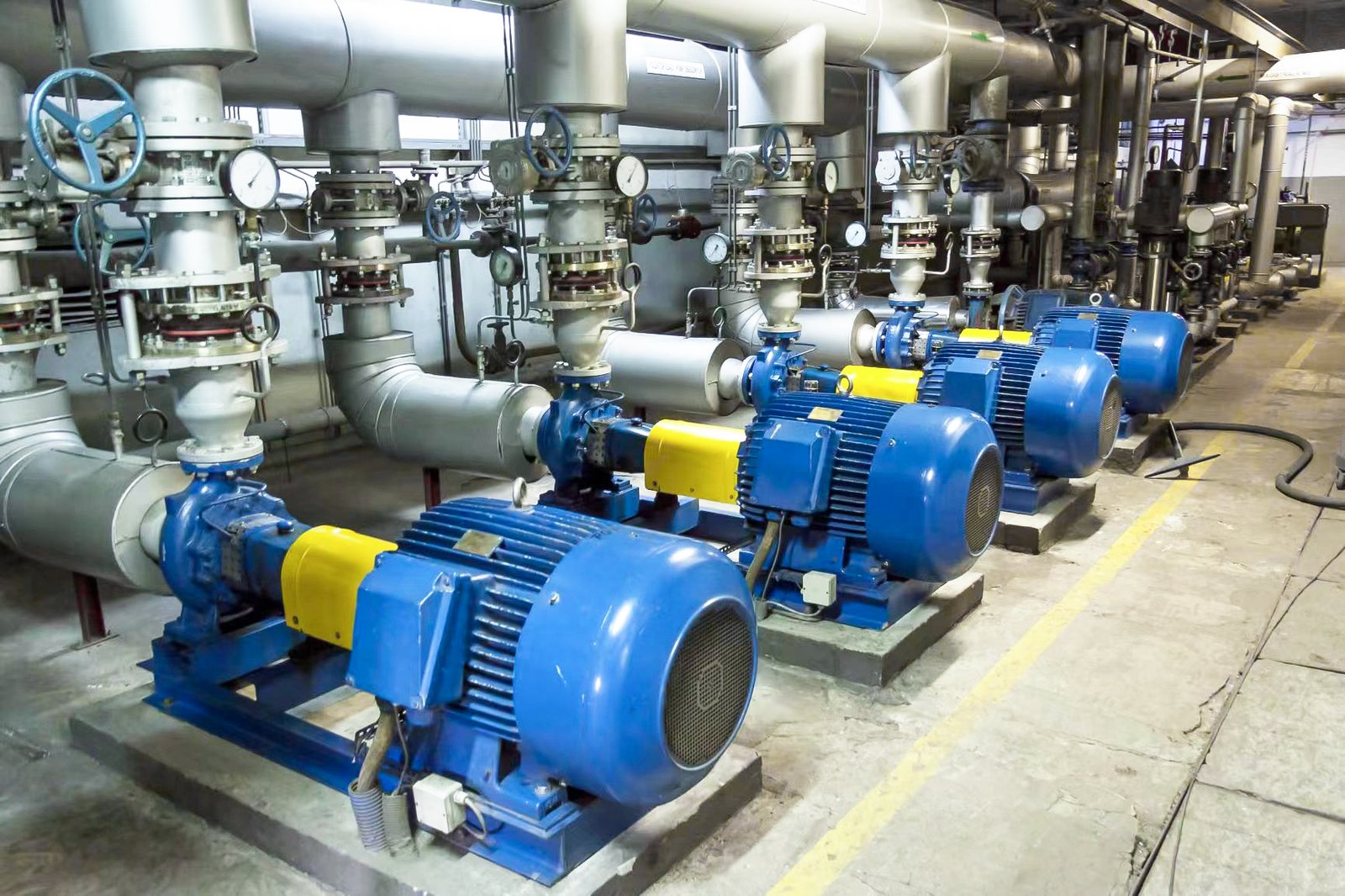
The production system of a large natural-gas purification enterprise was equipped with circulating pump systems. It was originally configured with 200 kW high-voltage motors and operated at constant speed with industrial-frequency power. The system used traditional outlet-valve throttling for regulation, with two units in service and one standby. During long-term operation, the normal valve opening was only 20%–30%; a large amount of electrical energy was lost in valve throttling and redundant pipeline resistance, resulting in extremely low energy-use efficiency. At the same time, throttling operation caused abnormal motor-load fluctuations and frequent over-power operation. This not only kept energy consumption high, but also created risks such as equipment overload and poor operating stability, while equipment failure rates and maintenance costs remained high. In response to the national energy-saving and carbon-reduction policy, to reduce production energy consumption and ensure stable equipment operation, the enterprise launched a dedicated energy-saving retrofit for its circulating-water pump system.
Core retrofit solution
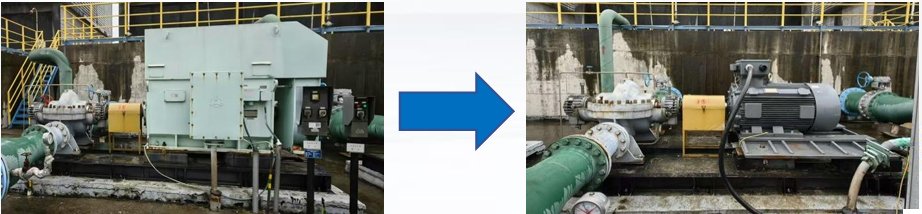
Through on-site investigation, operating-condition data collection, hydraulic-model calculation and multiple rounds of technical demonstration, the technical team combined the enterprise’s production-load characteristics with equipment operating pain points to formulate an integrated retrofit plan of high-voltage-to-low-voltage conversion, high-efficiency equipment replacement and intelligent variable-frequency regulation. The core retrofit work was: removing the original high-voltage power-supply equipment; replacing it with low-voltage, high-efficiency energy-saving motors; equipping it with Wolong dedicated variable-frequency drives and an intelligent automated control system; abandoning the traditional valve-throttling method; and precisely matching the flow and head required by production through variable-frequency speed regulation, eliminating throttling energy loss and enabling adaptive, high-efficiency operation of the pump system.
Project implementation results
This retrofit was delivered in a lightweight and highly efficient manner. After equipment arrival, the complete equipment installation, commissioning and trial operation were completed in only three days, quickly achieving stable operation. According to on-site measurement and verification by the enterprise, energy-consumption performance improved significantly after the retrofit: the electricity consumption of each pump unit fell from 199 kWh before the retrofit to 125 kWh after the retrofit, with an overall electricity-saving rate of 37%.
Based on the enterprise’s actual production conditions, the project’s economic benefit is considerable: calculated at an industrial electricity price of RMB 0.86/kWh and 8,000 continuous operating hours per year, ten pump-system units can save RMB 5.10 million in electricity costs each year. The project payback period is less than one year, truly achieving short-cycle payback and long-term cost reduction and efficiency improvement. At the same time, the retrofit completely resolved the motor over-power operation problem. Equipment noise and vibration were substantially reduced, the failure rate fell significantly, and system operating stability and safety improved comprehensively, receiving high recognition from the customer.
Project retrofit summary
This pump-system efficiency improvement retrofit for a natural-gas purification enterprise was not a simple equipment update, but a systematic energy-efficiency optimization based on intelligent control technology. By optimizing the power configuration, eliminating throttling loss and using AI to dynamically adapt to operating conditions, it thoroughly resolved the industry-wide problems of “oversized equipment for a light load, throttling loss and operating-condition imbalance” found in traditional industrial-frequency pump systems, while balancing energy-saving benefits, operating stability and investment cost-effectiveness. This solution is suitable for industrial circulating-water systems in chemical, purification, energy and similar industries. It is highly universal, quick to implement and delivers significant energy-saving results, providing a mature and replicable practical reference for pump-system energy-saving and carbon-reduction retrofits across industries.